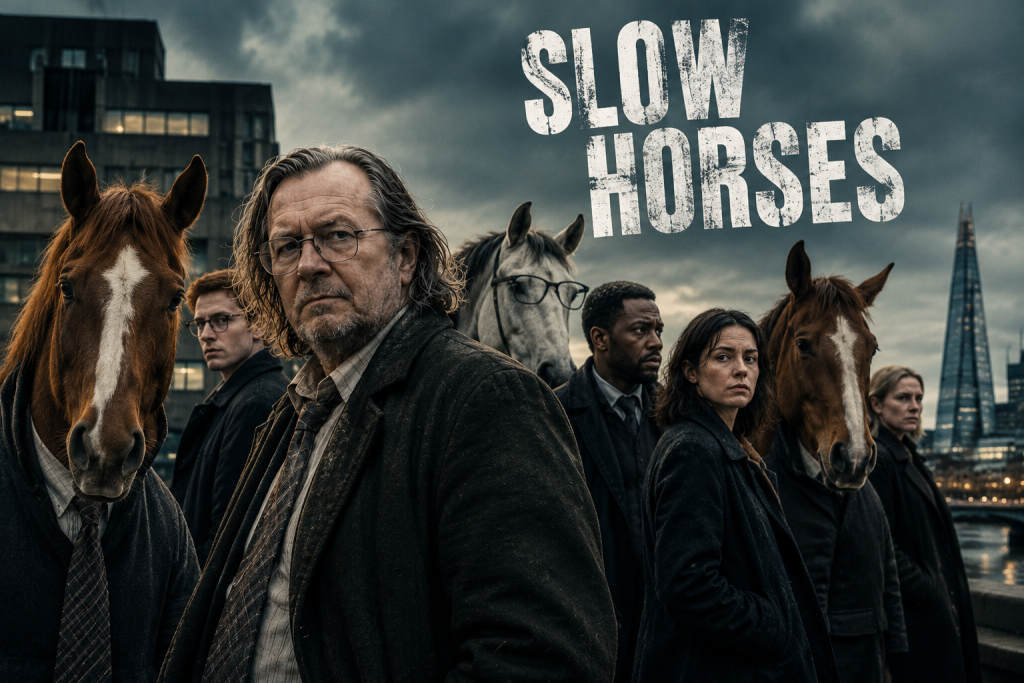
Spot the old nag
Brilliant though it is, Slow Horses remains something of a curate’s egg.
Now in its sixth season, the spy thriller has deservedly earned critical praise as well as a slew of awards.
Its darkly cynical take on a well-worn genre just about manages to avoid taking itself too seriously. In other words, it’s quintessentially British. It’s the antithesis of Hollywood’s idea of the British Secret Service, embodied by its standard bearer par excellence – James Bond.
Instead of slick glamorous agents, we get a dysfunctional group of socially awkward headcases, including an anti-Bond hero – the well-intentioned and long-suffering River Cartwright.
But its main star is unquestionably Gary Oldman as Jackson Lamb, the dishevelled and flatulent boss of this ramshackle gang.
Lamb treats personal hygiene like it’s an enemy of the state. In fact, he’s so disgusting you hope there’ll be an episode where he gets kidnapped and is forced to shower and shave.
Then there’s Kristin Scott Thomas as the snooty and devious MI5 boss, Diana Taverner, a role that was made for her, although I’d swear blind she’s been playing a version of this character for the past 30 years.
It’s effective, but it also raises the awkward question of whether the sneeringly condescending middle-class English trope is starting to wear a bit thin.
Fortunately, Slow Horses goes further by lambasting much of what’s wrong with present-day Britain; a world of self-serving careerists who are both inept and ruthless in equal measure.
The result is that the characters are all emotionally broken, whether they are the Slow Horses at Slough House or the corrupt and upwardly mobile agents at the Park.
The problem is that there’s not enough character development, and consequently we end up with caricatures.
Taverner is little more than a symbol of what the self-seeking civil servant looks like, while computer nerd Roddy Ho, Farage-doppelganger Dennis Gimball and smug spook James Webb – to name but three – are one-dimensional.
Thankfully, the series rises above predictable mediocrity by adding much needed splashes of humour, although even here it can sometimes grate.
Lamb’s withering put downs become tiresome after a while, and sometimes the trite repartee between the characters sounds like something Bodie and Doyle from The Professionals would have said in 1977. That was fine then, but not now.
Its main failing is that, despite the dollops of grey realism it’s short on emotional credibility and depth.
It may sound irrelevant, but those qualities are what made a series like Homeland so powerful, at least in the early seasons. Closer to home, the new British crime thriller, Legends, is also far more convincing.
Despite its shortcomings, Slow Horses gallops along at a satisfying pace. The latest season also seems to have addressed some of these failings (we’re only now beginning to find out why Lamb is such a dysfunctional bore).
Perhaps Lamb’s not a one-trick pony, after all, but if I hear one more fart joke, I swear I’ll get the glue factory on the blower.